
Tag Archive | "Ginny Burdick"

Oregon’s gun debate still open after Supreme Court ruling

June 28, 2010

Tags: , , , ,


BY RACHEL CHEESEMAN

WASHINGTON D.C.- The U.S. Supreme Court announced Monday that laws prohibiting possession of handguns in the home for purposes of self-protection are unconstitutional not only at the federal level, but also on the state and local level.

The case, MacDonald v. City of Chicago, was a contentious 5-4 decision that extended the ruling of District of Colombia v. Heller, which banned federal laws prohibiting handgun ownership in the homes of Washington, D.C. residents.

The opinion also mentioned constitutionally consistent regulations like those made to restrict felons from buying guns or people carrying them on school grounds or in government buildings.

Justice Samuel Alito wrote for the majority, saying, “Self-defense is a basic right, recognized by many legal systems from ancient times to the present day.” He said that self-defense was the “central component” of the Second Amendment.

Justices Stephen Breyer, Ruth Bader Ginsburg and Sonia Sotomayor joined in dissent, saying the Heller case had been decided incorrectly and that the gun protections don’t need to extend to local governments. They argued that the ownership of handguns was hotly disputed as a right and hardly could be considered fundamental. They also argued that even if it were, incorporation was not justified in this case as “there is no reason here to believe that incorporation of the private self-defense right will further any other or broader constitutional objective.”

Sen. Ginny Burdick, D-Portland, has been a strong advocate of gun safety legislation and said she wasn’t surprised by the ruling, finding it consistent with the ruling of Heller.

“The good news is that there is still plenty of room for regulation to keep guns out of the hands of children and criminals,” she said. “The government still has a very strong role in protecting public safety from gun violence.”

The New York Times called the ruling an “enormous symbolic victory for supporters of gun rights,” but some Oregon supporters seem less enthusiastic.

Kevin Starrett, of the pro-gun lobbying organization the Oregon Firearms Federation, said that while the ruling was a step in the right direction, it was a small one.

“The practical effect, I think, is pretty minimal,” he said. “I think it will encourage additional lawsuits, but I don’t see anything changing.”

Rep. Kim Thatcher, R-Keizer, was concerned with the narrow scope of the ruling, which applied only to possession in the home.

“I think people ought to be able to protect themselves, not just in their homes,” she said. “I don’t think your rights go out the window just because you walk into a government building.”

Thatcher said this ruling might chill any cities or counties that were considering passing such ordinances, but otherwise it would have very little impact on Oregon.

This is because of Oregon’s preemption clause, which gives the state legislature alone the power to make laws that restrict or regulate gun possession, sale and carry. So, Oregon cities and counties cannot pass any local gun control ordinances that would be affected by this ruling. Cities and counties, however, may have their own restrictions on loaded carrying.

However, Starrett said that the clause was violated “with the regularity of a metronome.” The issue was not so much with cities and counties passing ordinances as agencies prohibiting guns on their property without the legislature approving a law.

A well-known incident recently involved a school teacher who was told she could not have her handgun on school grounds, despite being a licensed carrier. She sued, but the Court of Appeals ruled in favor of the school district.

Other controversial issues included prohibitions on carrying, even for licensed carriers, at state fairs and in government buildings. Currently, the OFF is also involved in a lawsuit with the Oregon University system after a student with a concealed carry permit was expelled and arrested for having a gun on campus.

“The preemption statute, which was well-intended, means less and less,” Starrett said.

Burdick said she could sympathize with the desire of schools and universities to keep guns off school property and off campuses.

“For years I’ve been trying to give school boards clear authority to keep all guns out of schools,” she said. “Guns don’t belong in certain areas.”

Burdick said many gun owners favor reasonable regulations because they understand the responsibility of gun ownership, but that many of those regulations, like those that would prohibit carrying school and university property, have “fallen into the firestorm of the gun lobby.”

So while this ruling might be a symbolic victory for states like Illinois and Wisconsin with stricter gun regulations, it likely will do little to curb debate in Oregon.

“We will continue to have all the same battles that we’ve always had,” Starrett said. “I don’t see this ruling as changing that.”

New revenue forecast projects $560M budget shortfall

May 25, 2010

Tags: , , , , , , ,


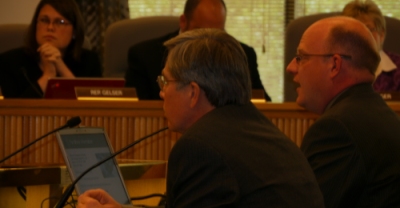
Tom Potowski and Josh Harwood from the Office of Economic Analysis present their forecast to the Joint Revenue Committee

BY SARAH ROSS

SALEM- Oregon’s leaders were caught by surprise Tuesday morning upon learning that the State now must endure a $560 million budget shortfall for the current biennium.

A presentation by Tom Potowski and Josh Harwood from the Office for Economic Analysis showed that the state’s revenues are short $560 million for the 2009-2011 biennium.

Before unveiling the large budgetary gap, Potowski urged the committee to see the positive signs that his office found.

“I’ve just given you a picture that I think is hopeful in that we’re starting to see the recovery and moving forward,” said Potowski. Yet, he acknowledged the disconnect between those signs and the reported shortfall.

The most noticeable difference between this forecast and the one given at the end of February was the decrease in personal income tax revenue by $798.1 million, adding to an overall decrease of $876.5 million for General Fund revenue.

Harwood added that the State’s Capital Gains income tax went down in 2009 by almost half, going from just under $4 billion to under $2 billion.

“We are not alone. All the states have seen this sort of situation where the final payments in the April period were down much farther then what they actually expected,” said Potowski.

He added that Oregon differs from other states in that it has not been able to cushion its decline, as many other states have with their sales taxes. He went on to say that Oregon’s situation therefore may look worse than other states because it is so dependent on the very volatile personal income tax.

Legislative leaders were taken aback by this news which, according to Senate President Peter Courtney, they didn’t see coming.

“This has been a sobering morning for us,” said Senate Revenue Committee Chairwoman Ginny Burdick, D-Portland. “We can’t put ourselves through this anymore and it really is time to do kicker reform.”

The shortfall will add an additional $200 million to the 2011-2013 projected budget shortfall of $2.6 billion, projected in the March forecast.

In Tuesday’s press conference, House Speaker Dave Hunt reinforced that the shortfall would be even greater if the tax measures 66 and 67 had not passed.

However, Hunt’s declaration did not stop House Minority Leader Bruce Hanna from issuing his own statement blaming the shortfall on Legislative leadership.

“Rather than working with the private sector to encourage job growth, Oregon’s businesses have been stifled by job-killing taxes and mandates. It’s no surprise that April’s tax collections were ‘dismal,’ because the Democratic supermajority has done nothing to improve our private sector economy,” wrote Hanna.

BETC's unlikely coalition

November 12, 2009

Tags: , ,


BY SARAH ROSS

PORTLAND- Following the embarrassment of Governor Ted Kulongoski’s Business Energy Tax Credit in the past few weeks, a group has formed behind the scenes to try to bring improvement to this system which has been termed by many as wasteful.

Among this group, an unusual allegiance has formed, including representatives of the powerful labor union AFLCIO, the progressive Tax Fairness Oregon, the free-market based think tank Cascade Policy Institute, the liberal-leaning Oregon Center for Public Policy, and House Revenue Committee Chairman Phil Barnhart (D-Eugene) and Senate Finance and Revenue Committee Chairwoman Ginny Burdick (D-Portland). Leading this diverse coalition is Jody Weiser of Tax Fairness Oregon.

“We can tell a public policy issue is important when the right, the left, and everyone in between can come together for much needed reform,” said Todd Wynn, a policy analyst with the Cascade Policy Institute.

Reformers on the left are asking for minor alterations of the tax credit program, which they call a blatant welfare handout to corporations and a bandit taking money from education, healthcare, law enforcement, and other similar government programs.

Conversely, reformers on the right call the program wasteful, especially considering the tax measures being presented to the public in January. Those same activists also consider the tax credits unnecessary to draw renewable energy into the state, as per its original intention.

Even with the release of new Administrative Rules from the Oregon DOE designed to slow the program’s growth and eliminate fraud, reformers are still not satisfied. They call these rules a temporary fix which in fact could conflict with existing law.

Instead, some solutions proposed by the group include having more oversight of and transparency in the program, prohibiting energy producers from receiving the credit for energy sold out-of-state, changing payback periods, limiting credit to liability, and providing direct government grants rather than tax credits. Additionally, they are seeking to revise the controversial pass-through option which allows companies to sell their tax credits to another company if the credit surpasses their tax liability.

This unlikely coalition is seeking to bring a new bill into February’s Interim Legislative Session to make the program better fiscally controlled.